Choosing an urban electric motorcycle is less about chasing the biggest battery or fastest speed. It is about how the machine fits your actual week. Picture a crowded curb, a steep parking ramp, and a damp ride home after work. These details matter. So do seat height, low-speed balance, braking feel, and whether the bike fits your parking space.
Gogoro founder Horace Luke has emphasized battery swapping as a way to make electric two-wheelers more convenient. This is a paraphrase, not a verbatim quotation. The idea points to a useful test: can you keep the motorcycle charged without changing your routine? Compare real-world range, charging time, battery access, warranty coverage, and local service support. A quoted range may shrink in cold weather, on hills, or with frequent stops. Check how the model handles those conditions, not just a smooth test ride. Small details count.
There is no perfect pick. A light model may feel nimble between traffic, yet less settled on rough pavement. A longer-range option can add weight and cost you may never need. Be honest about your routes. Measure your garage or parking area. Sit on the bike in your usual riding clothes. Then compare the total ownership costs, including charging equipment and scheduled maintenance. A short, repeatable test ride can reveal more than a glossy specification sheet. Choose for your commute, not for an imagined one.
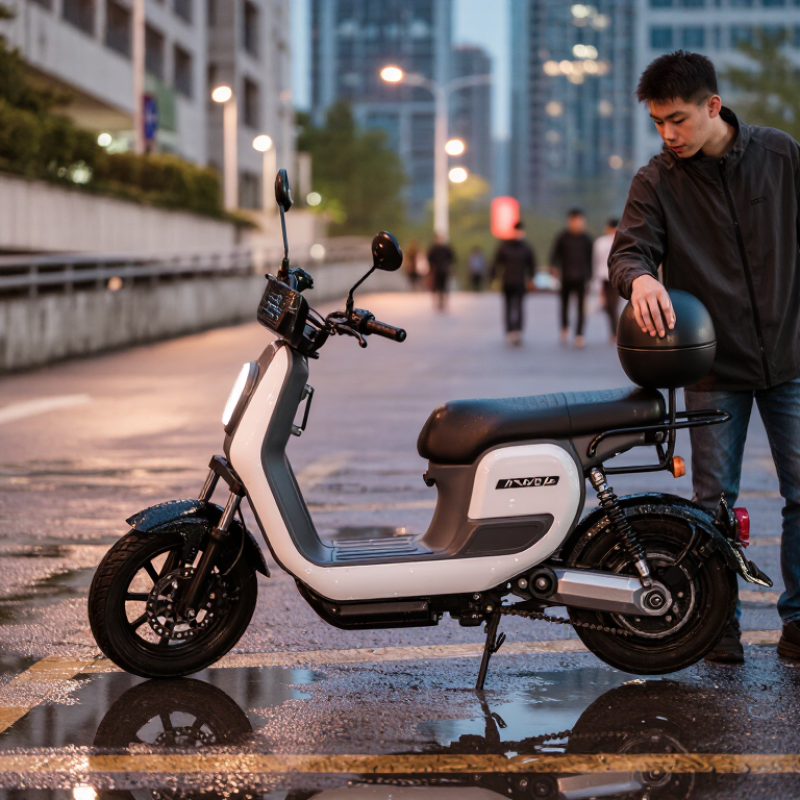
Set License and Power Needs: EU A1 Limits Are 11 kW and 0.1 kW/kg
Before choosing an urban electric motorcycle, check your licence category and the vehicle’s homologated figures. Under EU rules, an A1 motorcycle is limited to 11 kW maximum power and a power-to-weight ratio of 0.1 kW/kg. Both limits matter. A model below 11 kW can still exceed the ratio if it is especially light. Confirm the figures on the conformity documents, not just a sales listing; advertised peak output and legally relevant power may differ.
Do the math carefully. For example, 10 kW divided by 120 kg is about 0.083 kW/kg, below the stated threshold. But the legally defined vehicle mass may not match the curb-weight figure shown in a brochure. Ask the seller which homologated mass applies, and compare it with your licence entitlement. It is an easy detail to overlook.
Practical range and charging also deserve attention. The International Energy Agency’s Global EV Outlook 2024 reports nearly 10 million electric two- and three-wheeler sales worldwide in 2023, showing how quickly this segment is growing. That global figure does not predict a European model’s range. For a realistic commute, check battery capacity, expected energy use, passenger load, and cold-weather performance. A short test ride helps, though it cannot reproduce a wet winter journey. I would not choose on power alone.
Estimate Urban Range from Usable Battery kWh and Rated Wh/km
Urban range is easier to estimate when you use usable battery capacity, not the pack’s headline figure. Check the technical specification for usable kilowatt-hours. Multiply that number by 1,000, then divide by rated energy use in watt-hours per kilometre.
For example, a motorcycle with 4.2 usable kWh and a rating of 65 Wh/km gives a calculated range of about 65 km. That is a baseline, not a promise. Rated consumption may come from controlled testing, while city rides include traffic lights, cold starts, hills, and repeated acceleration. Real streets differ.
Keep a margin. If you reserve 20 percent for variation, the example leaves roughly 52 km for planning. The right margin depends on your route, rider weight, weather, and riding pace. A passenger or steep garage ramp can matter more than expected. Tire pressure matters, too. Not quite. Track a few normal trips and compare distance with battery use; the result can reveal whether your daily route fits comfortably. Be cautious with very precise estimates, because battery displays and riding conditions are not perfectly consistent.
Compare Charging Time Using Battery Capacity (kWh) and Charger Power (kW)
For an urban electric motorcycle, compare battery capacity with charger output, not the socket label alone. A basic estimate is battery energy in kWh divided by charging power in kW. A 4 kWh battery paired with a 1 kW charger needs about four hours from empty under ideal conditions. Real charging takes longer. Conversion losses, temperature, battery-management limits, and slower charging near full capacity all affect the result. Check whether a quoted power rating describes the onboard AC charger or a separate DC charging input; they are not interchangeable.
The IEA’s Global EV Outlook 2024 reports nearly 10 million electric two- and three-wheelers sold worldwide in 2023, making everyday charging practicality increasingly relevant. Charging a 4 kWh battery from 20% to 80% requires about 2.4 kWh. At 0.8 kW of delivered power, that takes roughly three hours before losses or charging slowdowns. That estimate is imperfect. Ask how the figure was measured, and verify the supplied charger’s actual output. A two-hour workplace stop may not refill a large battery on a low-power charger. Small differences on paper can become a missed ride.
Check Weather Protection: IEC 60529 IP67 Allows 1 m Immersion for 30 Minutes
When choosing an urban electric motorcycle, treat IP67 as useful evidence, not a promise that every wet-weather ride is risk-free. Under IEC 60529, the rating indicates dust protection and testing for immersion in water up to 1 meter for 30 minutes. That is a controlled test. It does not automatically cover repeated puddle impacts, forceful spray, saltwater, or seals worn by age and vibration.
Look closely at how the battery compartment, charging port, and cable entries are protected. These details matter when rain runs down the frame or water collects around a connector. Ask whether the rating applies to the complete motorcycle or only selected components. Check the owner’s manual for charging guidance after exposure to rain, and never assume a wet charging socket is safe to use.
Small details count. A tightly fitted port cover can help, but it cannot undo damaged seals. Even a strong rating has limits. I would compare the IP claim with the maker’s care instructions and warranty terms, then inspect exposed seals during routine cleaning. That extra check may feel fussy. Still, real streets are messier than a test tank, and an IP67 label alone cannot tell you how well a particular motorcycle will age through years of wet commutes.
How to Choose the Best Urban Electric Motorcycle - Check Weather Protection: IEC 60529 IP67 Allows 1 m Immersion for 30 Minutes
| IEC 60529 rating |
Dust protection |
Water protection |
What it means for urban riding |
Key limitation |
| IP54 |
Dust-protected; some dust may enter, but not enough to interfere with normal operation. |
Protected against splashing water from any direction. |
A basic level for splashes and light rain when the motorcycle is used as directed. |
Does not establish protection against water jets or immersion. |
| IP55 |
Dust-protected; some dust may enter, but not enough to interfere with normal operation. |
Protected against water jets from any direction. |
Offers a higher specified water-exposure level than splash protection for exposed, rated enclosures. |
Does not establish protection against immersion. |
| IP65 |
Dust-tight. |
Protected against water jets from any direction. |
A useful specification to check for dust-tight electrical enclosures exposed to rain or cleaning jets within test conditions. |
Does not establish protection against immersion. |
| IP67 |
Dust-tight. |
Protected against temporary immersion in water up to 1 m for 30 minutes under the specified test conditions. |
Provides a defined immersion rating for the specific enclosure or component tested. |
Does not mean the entire motorcycle is waterproof or suitable for riding through floods; water-jet protection is not implied by IPX7. |
Buying check: Confirm which parts the rating applies to—such as the battery enclosure, controller, display, and connectors—and follow the manufacturer’s care and charging instructions. IEC 60529 ratings apply to tested enclosures under specified conditions; they do not guarantee protection after damage, wear, or improper reassembly.
Verify Motorcycle Braking Compliance Under UNECE Regulation No. 78
How to Choose the Best Urban Electric Motorcycle
For city riding, braking should feel steady at low speeds and predictable in stop-and-go traffic. UNECE Regulation No. 78 sets braking requirements for L-category vehicles, including motorcycles. Ask the seller for approval documents showing compliance, and check that they cover the exact model and version you are considering. A similar-looking model may have different equipment. Paperwork matters.
Tips: Request the type-approval certificate and, if available, a test summary. Check which braking system is fitted, such as ABS or combined braking, where applicable. Ask how regenerative braking interacts with the friction brakes. The hand lever should feel consistent, not vague.
A short, careful test ride can reveal details documents cannot. On a quiet, safe route, try gentle stops at several speeds and notice whether the motorcycle tracks straight. Listen for unusual scraping, and check for warning lights before riding. Wet roads and a heavy load can change stopping behavior, so do not treat one dry-road ride as proof of safety. I would also ask about brake inspection intervals; this is easy to overlook when comparing range and charging time.
Conclusion
Choosing the right urban electric motorcycle starts with matching its power and licensing requirements to your needs. For an EU A1 category, the stated limits are 11 kW of maximum power and a power-to-weight ratio of no more than 0.1 kW/kg. Check the motorcycle’s specifications and your intended use before comparing models. To estimate practical city range, divide usable battery capacity in kWh by the rated energy consumption in kWh per kilometre, or convert the figures from Wh/km for a consistent calculation. Treat the result as an estimate, since riding conditions can affect range.
Compare charging times by relating battery capacity to the charger’s power, while allowing for charging losses and slower charging near full capacity. For wet-weather resilience, check the IP rating of relevant components: IP67 indicates protection against dust and temporary immersion under specified test conditions, not a guarantee for every part of the motorcycle. Finally, review braking information and verify compliance with UNECE Regulation No. 78. These checks help you assess suitability, convenience, and safety for everyday urban travel.